

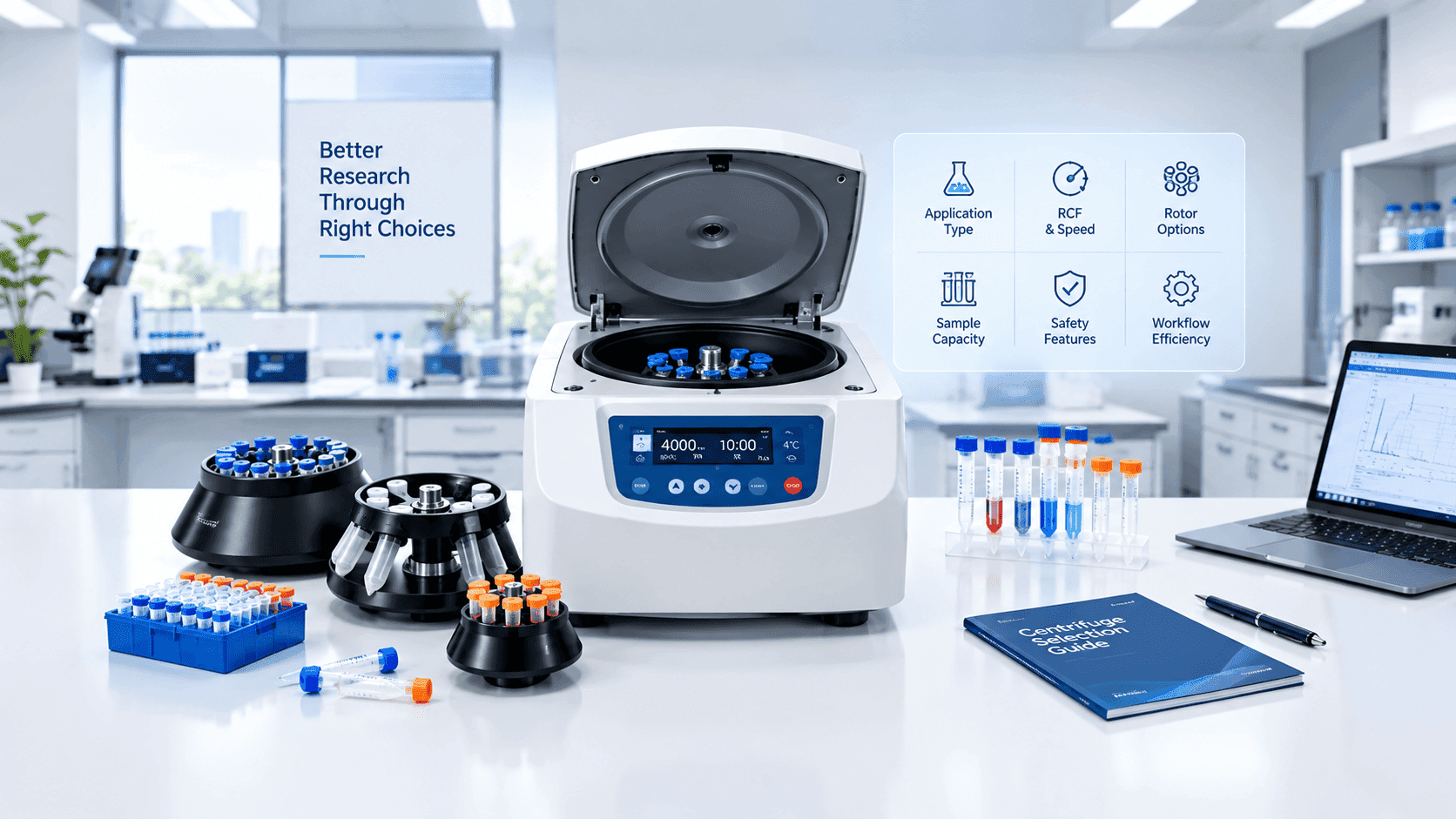
A centrifuge can look deceptively simple: load tubes, close the lid, set a speed and start the run. In practice, centrifugation is an engineered separation process. The result depends on the sample, vessel, rotor geometry, relative centrifugal force, temperature, run time and acceleration/deceleration profile.
That is why choosing a centrifuge by maximum RPM alone is rarely enough. Eppendorf's centrifugation guidance recommends considering sample type, vessel, centrifuge type, rotor, required relative centrifugal force and temperature. Thermo Fisher likewise recommends mapping current and anticipated applications before selecting a centrifuge and its accessories.
The short answer: which centrifuge should you choose?
Application | Starting point | Key considerations |
Routine sample preparation | Benchtop/general-purpose centrifuge | Tube formats, capacity, RCF and ease of use. |
Molecular biology / nucleic acids | Microcentrifuge or versatile benchtop centrifuge | Small-volume tubes, high RCF and rotor compatibility. |
Cell culture | General-purpose or refrigerated centrifuge | Tube capacity, RCF, temperature and throughput. |
Blood / clinical sample processing | Clinical or IVD-appropriate centrifuge | Validated application, tube type, RCF and regulatory requirements. |
Temperature-sensitive samples | Refrigerated centrifuge | Temperature range, control and rotor capacity. |
Density-gradient separation | Swing-bucket rotor | Horizontal separation and gradient integrity. |
High-g centrifugation | Fixed-angle / high-speed system | Required RCF, rotor rating and sample vessel. |
Microplates | Plate-compatible rotor or centrifuge | Plate format, adapters and swing-out geometry. |
High-throughput processing | Large-capacity swing-bucket or floor centrifuge | Capacity, rotor flexibility and cycle time. |
1. Start with the separation not the machine
Before comparing centrifuges, write down what the centrifugation step is supposed to accomplish. Are you pelleting cells, separating serum or plasma, concentrating nucleic acids, clarifying a lysate, separating particles by density, or processing many samples at once?
The application determines the required RCF, rotor geometry, vessel, temperature and capacity. A microcentrifuge that is excellent for 1.5 or 2 mL tubes may be completely unsuitable for a 50 mL cell-culture workflow. Conversely, a large floor centrifuge can be unnecessary for routine molecular-biology sample preparation.
2. RCF vs. RPM: the distinction every buyer should understand
RPM means revolutions per minute. It tells you how quickly the rotor is spinning, but it does not by itself tell you the centrifugal force applied to the sample.
RCF means relative centrifugal force and is expressed as multiples of gravitational acceleration, commonly written as ×g. It accounts for rotor radius as well as rotational speed. A common relationship is:
RCF = 1.118 × 10⁻⁵ × r × RPM²
where r is the rotational radius in centimeters. Because radius differs between rotors, two centrifuges running at the same RPM can produce different RCF values.
For protocol transfer and equipment selection, RCF is therefore usually the more useful specification. Eppendorf specifically emphasizes using the RCF required by the protocol rather than relying only on rotor speed.
3. Fixed-angle vs. swing-bucket rotors
Rotor design is one of the most important centrifuge-selection decisions. The two most common laboratory rotor families are fixed-angle and swing-bucket.
Feature | Fixed-angle rotor | Swing-bucket rotor |
Tube position during run | Remains at a fixed angle | Swings toward horizontal |
Typical strength | High RCF and compact pellets | High capacity and flexible vessel formats |
Pellet position | Often along the lower side/wall of the tube | Generally centered at the bottom |
Density-gradient centrifugation | Usually not the preferred geometry | Commonly preferred/required for horizontal gradients |
Plate processing | Application-dependent | Commonly suited to plates with appropriate buckets |
High throughput | Can be useful | Often advantageous |
Typical use | Pelleting cells, subcellular fractions and high-g applications | Gradients, plates, high-capacity sample processing |
Eppendorf notes that fixed-angle rotors are suited to high g-forces and compact pellets, while swing-bucket rotors offer vessel flexibility, high throughput and are required for gradient centrifugation where horizontal layers must form.
4. Benchtop centrifuges
Benchtop centrifuges are a common choice for routine laboratory workflows because they balance capacity, footprint and versatility. They may support interchangeable rotors for microtubes, conical tubes, plates or other vessels depending on the platform.
For a general-purpose laboratory, look beyond maximum speed. Evaluate the rotor ecosystem, adapters, tube compatibility, capacity per run, RCF, acceleration/deceleration, temperature control and whether the instrument can grow with the laboratory's applications.
5. Microcentrifuges
Microcentrifuges are optimized for small-volume tubes, commonly used in molecular biology and sample-preparation workflows. They are useful where the laboratory works primarily with microliter-to-milliliter-scale samples and requires relatively high RCF in a compact footprint.
Thermo Fisher's current microcentrifuge range, for example, includes systems designed for microtube processing and nucleic-acid minipreps, illustrating the application-specific design of this class.
6. Refrigerated centrifuges
Refrigeration becomes important when sample temperature can affect biological activity, molecular stability, viscosity or separation behavior. A refrigerated centrifuge can help maintain a defined temperature during the run, but the useful specification is not simply 'has refrigeration.'
Required operating temperature range
Temperature control and stability
Pre-cooling capability where relevant
Rotor capacity at the required temperature
Heat generated during high-speed operation
Compatibility with the laboratory's sample workflow
Current Thermo Scientific refrigerated centrifuges are offered with different rotor configurations and application packages, illustrating how temperature, rotor and capacity are selected as a system rather than independently.
7. High-speed and high-RCF centrifuges
High-speed centrifugation is appropriate when a protocol requires high RCF to sediment smaller particles or achieve a particular separation. However, the centrifuge's maximum RPM should never be evaluated separately from rotor radius and maximum RCF.
High-RCF operation also increases the importance of rotor inspection, vessel compatibility, balancing, lid/interlock systems and correct operating procedures. The rotor—not just the centrifuge motor—has a defined operating envelope.
8. Capacity: more tubes per run can change productivity
Capacity should be calculated as usable samples per cycle, not just the largest nominal rotor volume. A centrifuge that holds fewer tubes but completes runs quickly may outperform a larger instrument in some workflows; in other applications, high-capacity swing buckets may significantly reduce the number of cycles.
Capacity question | Why it matters |
How many samples per run? | Determines batch throughput. |
Which tube formats? | Affects rotor and adapter selection. |
Mixed vessel formats? | May require interchangeable adapters or rotors. |
Plates required? | Requires compatible plate carriers/rotors. |
Sample volume? | Determines tube and bucket capacity. |
Future volume growth? | May justify a larger rotor platform. |
9. Acceleration and deceleration matter too
The separation does not happen only at maximum speed. How quickly a centrifuge accelerates and decelerates can affect the workflow and, in some applications, the separation itself. Soft braking can be useful where disturbing a gradient or pellet is undesirable, while rapid acceleration/deceleration can improve throughput for routine workflows.
When comparing instruments, ask whether acceleration and braking profiles are programmable and whether protocols can store different settings.
10. Tube, vessel and adapter compatibility
A centrifuge is only as useful as the vessels and adapters it can safely accommodate. Check the exact tube material, dimensions, nominal volume, cap design and maximum allowable RCF. Do not assume that a tube that physically fits a rotor is automatically rated for the required force.
Thermo Fisher's current application packages illustrate this approach by pairing centrifuges with specific rotors, buckets and adapters for defined workflows.
11. Safety and biocontainment
Centrifuges store significant kinetic energy, so safety features are part of the equipment specification—not optional extras.
Lid interlock and locking system
Imbalance detection
Rotor recognition or speed limitation where available
Aerosol-tight or sealed lids for appropriate biological applications
Rotor inspection and documented service
Compatible containment accessories
Clear operating procedures for loading and balancing
For clinical or potentially hazardous biological workflows, the appropriate containment configuration and institutional biosafety requirements should be established before procurement. Thermo Fisher's current clinical/research centrifuge listings include features such as biocontainment-certified configurations and sealed lids for applicable workflows.
12. Clinical vs. research centrifuges
Clinical laboratories may need equipment with specific certifications or regulatory status for diagnostic workflows, while research laboratories may prioritize versatility and rotor flexibility. These are not interchangeable procurement criteria.
Thermo Fisher's centrifuge buying guidance explicitly recommends determining whether an application requires IVD/medical-device status or a general-use instrument before selecting the centrifuge.
13. Noise, footprint and ergonomics
A centrifuge may run many times per day, so operational ergonomics can materially affect laboratory usability. Consider bench footprint, rotor access, lid height, loading height, controls, display readability and noise.
For shared laboratories, a clear interface and straightforward rotor exchange can reduce training time and user errors.
14. Programmability and digital workflow
Modern centrifuges may offer programmable runs, stored methods, event logs, automatic rotor recognition, touch interfaces and other workflow features. These are valuable when many users share the instrument or when protocols must be standardized.
Do not pay for software features without identifying the workflow they improve. For a simple teaching laboratory, reliable controls and easy operation may be more valuable than a complex automation layer.
15. A practical laboratory centrifuge selection framework
1. List every current and anticipated centrifugation application.
2. Identify the sample type, volume and vessel.
3. Determine the RCF required by each protocol.
4. Check whether the protocol specifies a rotor type or geometry.
5. Decide whether fixed-angle, swing-bucket or both are required.
6. Determine the required capacity and samples per run.
7. Decide whether refrigeration is necessary.
8. Check maximum RCF, speed range and rotor-specific limits.
9. Review acceleration and braking requirements.
10. Confirm tube, plate, bucket and adapter compatibility.
11. Define safety, containment and regulatory requirements.
12. Evaluate footprint, noise, controls and service support.
13. Compare total lifecycle cost, including rotors, adapters and maintenance.
14. Validate the selected configuration against representative protocols.
16. Common mistakes when buying a centrifuge
Choosing by maximum RPM rather than required RCF.
Ignoring rotor radius when comparing RPM between centrifuges.
Buying a centrifuge without the rotor and adapters required by the actual protocol.
Choosing fixed-angle when the workflow requires horizontal density gradients.
Buying refrigeration when sample requirements do not justify it or omitting it where temperature control is critical.
Comparing nominal capacity rather than useful samples per run.
Assuming every tube that fits physically is rated for the required RCF.
Ignoring acceleration and deceleration behavior.
Overlooking aerosol containment for appropriate biological workflows.
Failing to budget for additional rotors, buckets, adapters, seals and maintenance.
Selecting a clinical/IVD workflow instrument without verifying the required regulatory status.
Treating the centrifuge body and rotor as separate purchasing decisions.
17. Application-to-centrifuge guide
Application | Centrifuge configuration to evaluate | Primary considerations |
Molecular biology | Microcentrifuge / compact benchtop | Small tubes, high RCF, rotor compatibility. |
Cell culture | General-purpose benchtop / refrigerated | 15/50 mL formats, capacity, RCF, temperature. |
Clinical serum/plasma | Clinical/IVD-appropriate centrifuge | Validated protocol, RCF, tube format and regulatory status. |
Density-gradient separation | Swing-bucket | Horizontal gradient formation and bucket/adapters. |
Routine pelleting | Fixed-angle | Compact pellets, RCF and run time. |
Microplates | Swing-bucket/plate rotor | Plate compatibility and adapters. |
Temperature-sensitive samples | Refrigerated centrifuge | Temperature control and rotor capacity. |
High-throughput processing | Large-capacity swing-bucket/floor model | Samples per run, cycle time and workflow ergonomics. |
High-RCF research | High-speed fixed-angle system | Maximum RCF, rotor rating and vessel compatibility. |
Final takeaway
The right laboratory centrifuge is not necessarily the fastest or largest instrument. It is the system that matches the sample, vessel, required RCF, rotor geometry, temperature, capacity, safety requirements and workflow.
Start with the protocol. Identify the required RCF rather than relying on RPM, then choose the rotor, vessel and capacity. Add refrigeration when sample temperature requires it, and evaluate safety, containment, acceleration, braking and serviceability as part of the same purchase decision.
For laboratories with diverse applications, a versatile centrifuge platform with interchangeable rotors and adapters can be valuable. For highly specialized workflows, a dedicated centrifuge may offer better fit and reproducibility. The correct choice is determined by the separation task not by the headline specification.