

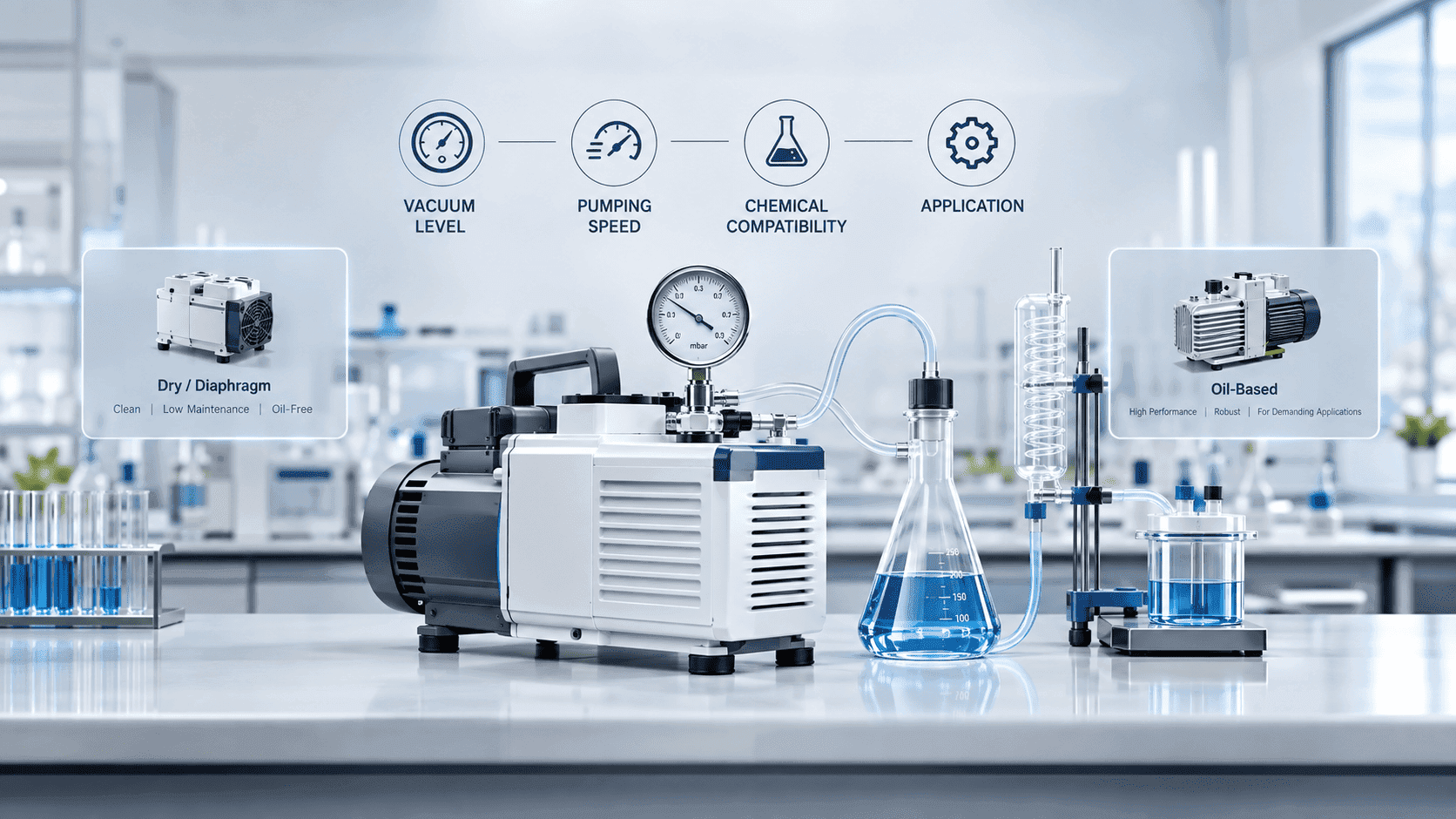
A vacuum pump is often treated as an accessory to a laboratory instrument. In many workflows, that is a mistake. The pump influences how quickly a system reaches vacuum, how deeply it can operate, how it handles solvent or water vapor, how much maintenance it requires and how reliably the connected process runs.
The right laboratory vacuum pump cannot be selected by ultimate vacuum alone. Application, pumping speed, vapor load, chemical compatibility, required control, duty cycle, noise, maintenance and connected equipment all matter. Current VACUUBRAND guidance similarly puts application, media, quantity, process accuracy and specific requirements at the center of pump selection.
The short answer: which pump should you choose?
Application | Starting point | Key selection factor |
Vacuum filtration | Diaphragm pump | Required vacuum and pumping speed. |
Rotary evaporation | Chemical-resistant diaphragm / chemistry pump | Vacuum control, solvent compatibility and vapor handling. |
Vacuum drying | Diaphragm, rotary vane, scroll or hybrid | Target pressure and vapor/chemical load. |
Freeze drying | Rotary vane, scroll or hybrid | Deep vacuum and vapor handling. |
Schlenk line / inert chemistry | Chemical-resistant fine-vacuum pump | Deep vacuum, condensate tolerance and chemical resistance. |
General laboratory vacuum | Diaphragm or suitable general-purpose pump | Pressure range, duty cycle and contamination tolerance. |
Start with the process, not the pump
Ask first what the laboratory is trying to accomplish: filtration, evaporation, drying, concentration, freeze drying, inert-gas work or another process. These workflows do not place the same demands on a pump.
Filtration often needs moderate vacuum; rotary evaporation needs controlled pressure and solvent-vapor management; freeze drying requires substantially deeper vacuum and vapor handling. Labconco and VACUUBRAND both emphasize application-specific selection.
Understand the two specifications buyers see first
Ultimate vacuum
Ultimate vacuum describes the lowest pressure a pump can achieve under specified conditions. Lower absolute pressure means a deeper vacuum. It is commonly reported in mbar, Pa or Torr.
A pump should be capable of reaching a lower pressure than the application's target, but the published ultimate-vacuum figure does not guarantee that pressure in the complete system. Tubing, leaks, traps, valves, chamber volume and vapor load affect actual performance.
Pumping speed
Pumping speed describes how quickly gas can be removed under specified conditions, often reported in L/min or m³/h. It influences evacuation time and gas/vapor handling.
Specification | Main question | Why it matters |
Ultimate vacuum | How deep can pressure be reduced? | Determines whether the target pressure is achievable. |
Pumping speed | How quickly can gas be removed? | Influences evacuation time and load handling. |
Vapor tolerance | How well can condensable vapors be handled? | Critical for evaporation, drying and freeze drying. |
Chemical compatibility | What media can contact the pump? | Protects performance and service life. |
Vacuum control | Can pressure be regulated accurately? | Important for controlled evaporation and reproducibility. |
Diaphragm vacuum pumps
Diaphragm pumps are generally oil-free pumps in which a flexible diaphragm moves gas through valves. They are widely used where clean, low-maintenance vacuum and chemical resistance are important.
Current laboratory guidance identifies diaphragm pumps for applications such as filtration, distillation, rotary evaporation, vacuum concentration and selected drying applications; exact pressure range varies by model.
Oil-free operation
Low routine maintenance compared with oil-sealed pumps
Chemical-resistant configurations are available
Suitable for many filtration, evaporation and general laboratory workflows
Limitation: many diaphragm pumps do not reach the deep vacuum required for every freeze-drying or fine-vacuum application.
Rotary vane vacuum pumps
Rotary vane pumps are oil-sealed pumps capable of achieving substantially deeper vacuum than many diaphragm pumps. They are widely used where deep vacuum is required, including many freeze-drying workflows.
The trade-off is oil management. Solvent or corrosive vapors entering the pump can contaminate or degrade the oil, so condensers, cold traps and suitable operating procedures may be important. Labconco specifically warns that untrapped solvent vapor can condense in rotary-vane pump oil.
Chemical-resistant pumps
When acids, aggressive solvents or corrosive vapors are involved, chemical compatibility can matter more than achieving the deepest possible pressure. Chemical-resistant diaphragm, screw, hybrid and other designs are available depending on the required vacuum range.
VACUUBRAND recommends chemistry diaphragm or chemically resistant screw pumps for aggressive vapors, while Labconco describes chemically resistant and hybrid designs for corrosive applications.
Always check the actual chemical, concentration, temperature and exposure conditions against the manufacturer's compatibility documentation.
Scroll vacuum pumps
Scroll pumps are dry, oil-free pumps that can provide deeper vacuum than many diaphragm pumps. They can be attractive when a laboratory wants to avoid pump oil while still requiring substantial vacuum performance.
Labconco describes dry scroll pumps as low-maintenance options used in freeze drying and sample preparation, while noting that upfront cost can be higher than some alternatives.
Hybrid or combination pumps
Hybrid pumps combine different pumping mechanisms to balance deep vacuum, vapor handling and chemical compatibility. A common laboratory architecture combines rotary-vane and diaphragm sections.
The diaphragm section can help reduce vapor condensation in the oil system. Labconco describes this design as a way to reduce oil contamination and extend service intervals.
Choose by application
Application | Pump category to evaluate | Primary criteria |
Vacuum filtration | Diaphragm / chemistry diaphragm | Moderate vacuum, flow capacity, chemical compatibility. |
Rotary evaporation | Chemistry diaphragm / controlled pump | Pressure control, solvent resistance, pumping speed. |
Vacuum concentration | Diaphragm / hybrid / scroll | Vapor load, pressure range, chemistry. |
Vacuum oven | Diaphragm / rotary vane / scroll / hybrid | Target pressure, chamber volume, vapor load. |
Freeze drying | Rotary vane / scroll / hybrid | Deep vacuum, vapor tolerance, sample chemistry. |
Schlenk line | Chemical-resistant fine-vacuum pump | Deep vacuum, condensate tolerance, chemical resistance. |
General laboratory vacuum | Diaphragm or suitable general-purpose pump | Duty cycle, pressure and contamination tolerance. |
Vacuum filtration
Vacuum filtration often does not require the deep vacuum used for freeze drying. The pump should be sized around the filtration apparatus, desired filtration rate and sample chemistry.
VACUUBRAND currently recommends single-stage diaphragm or chemistry diaphragm pumps for filtration, with example ultimate-vacuum ranges around 70–100 mbar; required pumping speed depends on setup size. These are manufacturer recommendations, not universal requirements.
Rotary evaporation
Rotary evaporation is not simply about pulling the deepest possible vacuum. The objective is controlled evaporation at an appropriate boiling pressure while limiting bumping, foaming and unnecessary solvent loss.
VACUUBRAND's current guidance links required ultimate vacuum to solvent boiling behavior and highlights controllable diaphragm systems for controlled evaporation.
Freeze drying
Freeze drying relies on sublimation of frozen solvent and therefore places greater demands on vacuum depth and vapor management than ordinary evaporation.
Labconco identifies rotary vane, hybrid and scroll pumps as options for freeze drying, with selection influenced by whether samples are aqueous, solvent-containing or corrosive.
A cold trap or condenser is often important because it captures vapor before it reaches the pump.
Vacuum drying ovens
Vacuum ovens vary according to moisture, solvents, temperature and vapor load. The pump must reach the required pressure while tolerating what leaves the chamber.
VACUUBRAND distinguishes rough-vacuum and finer-vacuum laboratory drying applications, reinforcing that oven requirements must be evaluated by process rather than by a generic pump label.
Chemical compatibility and vapor handling
Risk | Potential problem | Protection strategy |
Solvent vapor | Condensation and contamination | Cold trap/condenser and compatible pump. |
Corrosive vapor | Internal corrosion | Chemical-resistant materials and vapor management. |
Water vapor | Condensation or reduced performance | Pump designed for vapor handling. |
Particulates | Internal contamination | Upstream filtration where appropriate. |
Liquid carryover | Mechanical damage / poor pumping | Prevent liquid entry; use suitable traps. |
Hazardous exhaust | Exposure risk | Appropriate exhaust routing and institutional controls. |
Vacuum control: when is it necessary?
A simple filtration setup may not need active electronic control. Controlled evaporation, however, can benefit from feedback-based regulation. VACUUBRAND explicitly identifies process accuracy and vacuum regulation as application-dependent requirements.
Pumping speed: bigger is not always better
A larger pump can evacuate a system faster, but excessive capacity does not necessarily improve the process. Evaporation may be limited by heat transfer, condenser capacity, solvent properties or pressure control. Select pumping speed based on chamber volume, gas load, vapor load, leakage and required evacuation time.
Noise, maintenance and total cost of ownership
Factor | Questions to ask |
Noise | Will the pump operate near students, researchers or offices? |
Oil | Does it require oil changes and monitoring? |
Consumables | What diaphragms, seals, filters or other parts recur? |
Service | Is trained service available locally? |
Downtime | How quickly can critical parts be replaced? |
Energy | What is expected power demand for the duty cycle? |
Lifecycle | Does a higher purchase price reduce maintenance or consumables? |
A practical selection framework
1. Define the application.
2. Specify the required operating pressure and acceptable range.
3. Determine the required ultimate vacuum.
4. Estimate pumping speed from system volume, gas load and desired evacuation time.
5. Identify all vapors, solvents, acids, bases, water and particulates that may reach the pump.
6. Decide whether oil-free operation is required.
7. Evaluate vapor tolerance and whether a trap, condenser or separator is needed.
8. Determine whether active vacuum control is required.
9. Check duty cycle, noise, maintenance and service requirements.
10. Validate the complete pump-plus-equipment system against current manufacturer specifications.
Common mistakes when buying a laboratory vacuum pump
Choosing the deepest advertised vacuum without considering the process.
Ignoring pumping speed and evacuation time.
Selecting an oil-sealed pump for solvent-heavy work without vapor management.
Assuming chemical resistance means compatibility with every chemical.
Using a deep-vacuum pump when a simpler pump meets the application.
Ignoring vacuum control where pressure must be regulated.
Failing to size the pump around connected equipment.
Allowing liquid carryover into the pump.
Not planning exhaust handling for hazardous vapors.
Comparing purchase price without considering oil, service, parts, downtime and energy.
Final takeaway
The right laboratory vacuum pump is not necessarily the pump with the lowest ultimate pressure or highest pumping speed. It is the pump whose vacuum range, capacity, vapor tolerance, chemical compatibility, control characteristics and maintenance profile match the actual process.
Start with the application, then define pressure, pumping-speed, vapor and chemical requirements. Only after that should you compare diaphragm, rotary vane, scroll, hybrid or other technologies. For solvent-heavy or corrosive processes, protecting the pump from vapors can be as important as selecting the pump itself.