

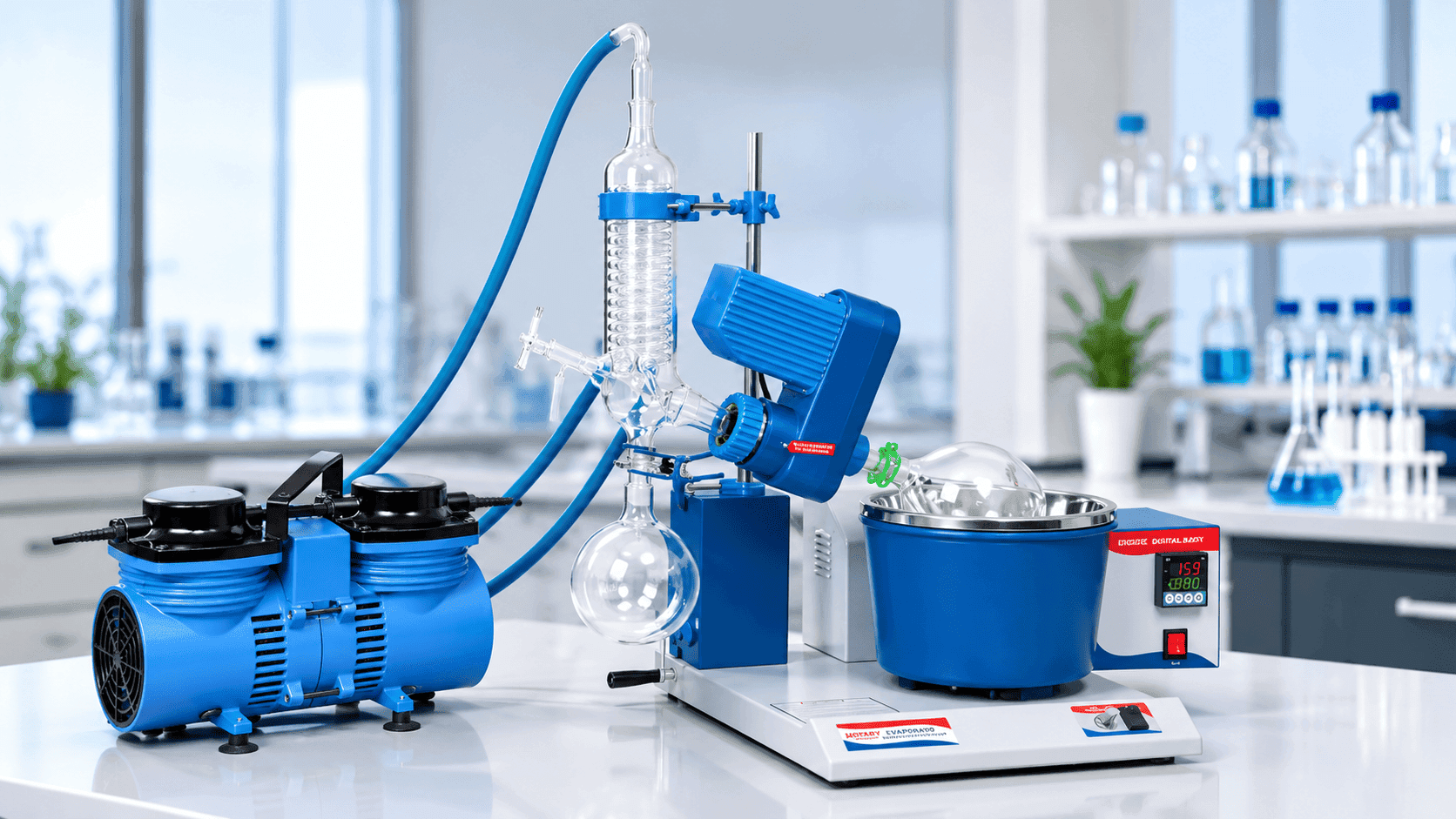
Removing solvents efficiently is a routine requirement in chemistry, pharmaceutical research, natural product extraction and many other laboratory workflows. However, when a sample contains heat-sensitive compounds or valuable dissolved materials, simply heating the liquid until the solvent evaporates may damage the product or compromise the results.
A rotary evaporator, also known as a rotovap or rotary vacuum evaporator, addresses this challenge by combining controlled heating, flask rotation and reduced pressure. The system evaporates a solvent under conditions that can be gentler than evaporation at atmospheric pressure, then condenses the resulting vapour for collection.
For laboratories, the benefits extend beyond faster solvent removal. The right configuration can improve sample concentration, support solvent recovery, reduce operator workload and make experimental procedures more repeatable.
Selecting an appropriate instrument requires more than comparing flask capacities or motor speeds. Solvent properties, vacuum control, condenser performance, cooling capacity, sample behaviour and the laboratory's daily workload all affect the outcome.
This guide explains how rotary evaporators work, where they are used, which specifications matter and how laboratories can select a system that meets their technical and operational requirements.
What Is a Rotary Evaporator?
A rotary evaporator is a laboratory instrument designed to remove volatile solvents from liquid mixtures under reduced pressure. It is commonly used to concentrate solutions, recover solvents and prepare samples for subsequent purification or analysis.
The instrument works by rotating a flask containing the sample while the flask is partially immersed in a controlled-temperature bath. A vacuum system lowers the pressure inside the apparatus, reducing the temperature at which the solvent boils. Vapour passes into a condenser, where it cools and returns to liquid form. The recovered solvent collects in a separate receiving flask.
The concentrated material generally remains in the evaporating flask.
Rotary evaporators are widely used in research laboratories, universities, pharmaceutical development facilities, chemical synthesis laboratories and natural product research.
They are particularly useful when conventional evaporation would take too long, require excessive heat or make solvent recovery inconvenient.
The central purpose is straightforward: remove a solvent efficiently while maintaining suitable conditions for the material left behind.
Working Principle of a Rotary Evaporator
The working principle of a rotary evaporator relies on four connected processes: pressure reduction, controlled heating, flask rotation and vapour condensation.
1. Vacuum reduces the solvent's boiling point
A liquid boils when its vapour pressure becomes equal to the pressure surrounding it. Reducing the pressure inside the rotary evaporator therefore allows the solvent to boil at a lower temperature.
For example, water boils at approximately 100°C at standard atmospheric pressure. Under sufficiently reduced pressure, it can boil at a substantially lower temperature.
The exact boiling temperature depends on the pressure and the solvent's vapour-pressure characteristics.
This is particularly useful for samples containing compounds that may degrade, oxidise or otherwise change when exposed to excessive heat. However, reduced pressure does not guarantee sample stability; the compound's actual thermal and chemical properties still matter.
2. Flask rotation spreads the liquid into a thin film
The evaporating flask rotates continuously as the instrument operates.
Rotation distributes the liquid over a larger area of the flask's inner wall, creating a thin film that promotes heat transfer and evaporation. It also helps maintain a more uniform liquid distribution.
This design can improve evaporation compared with heating a stationary flask containing the same volume of liquid.
Rotation also helps reduce sudden, uncontrolled boiling known as bumping, although it cannot eliminate bumping or foaming in every sample.
3. The heating bath supplies controlled thermal energy
The flask is partially immersed in a water or other compatible heating bath. Heat passes through the glass into the sample, supplying the energy needed for evaporation.
The appropriate bath temperature depends on several factors:
The solvent or solvent mixture.
The operating pressure.
The sample's thermal sensitivity.
The evaporation rate required.
The capacity of the condenser to handle the resulting vapour.
Increasing the bath temperature may accelerate evaporation, but excessive heating can damage sensitive samples or overwhelm the condenser.
A good operating method balances temperature, pressure and cooling rather than maximising any single setting.
4. The condenser converts vapour back into liquid
After evaporation, solvent vapour travels through the vapour duct into the condenser. Cooling water or a recirculating chiller removes heat from the vapour, allowing it to condense.
The resulting liquid flows into the receiving flask, where it can be collected for disposal, analysis or reuse, depending on its purity and the laboratory's procedures.
Condenser performance is important because vapour that is not adequately condensed may reach the vacuum pump or escape into the exhaust system.
How the four processes work together
Process | Primary function | Why it matters |
|---|---|---|
Vacuum | Lowers the boiling temperature | Supports evaporation at reduced temperatures |
Rotation | Spreads the sample into a thin film | Improves heat and mass transfer |
Heating bath | Supplies energy | Maintains the required evaporation rate |
Condenser | Cools and collects vapour | Supports solvent recovery and reduces vapour reaching the pump |
The system performs best when these components are correctly matched to the solvent, batch volume and intended application.
Main Components of a Rotary Evaporator
Understanding the individual components helps laboratory teams evaluate equipment specifications, troubleshoot common problems and plan for maintenance.
1. Evaporating flask
Holds the solution being concentrated. Its capacity, joint size and glass condition must suit the sample volume and operating conditions. The flask should not be filled to its nominal capacity; sufficient headspace is needed to reduce carryover and foaming.
2. Heating bath
Supplies controlled heat to the rotating flask. Water baths suit many routine laboratory applications, while other bath media may be required for specific temperature ranges. Temperature stability and safe flask positioning are key considerations.
3. Condenser
Removes heat from the solvent vapour so it returns to liquid form. Condenser design, cooling temperature, available surface area and vapour load influence solvent recovery.
4. Vacuum pump and control system
Reduces and regulates the pressure in the evaporation assembly. The pump must be compatible with the solvents and vapours involved. A controller can help maintain the required pressure and improve repeatability.
5. Receiving flask
Collects condensed solvent. Its capacity should accommodate the expected recovery volume, with sufficient headroom to avoid overfilling during operation.
Other important components include the rotation motor, vapour duct, vacuum seals, glass joints, clamps, lift mechanism and cooling connections. These should be considered part of the complete instrument rather than treated as incidental accessories.
Applications of Rotary Evaporators in Laboratories
Rotary evaporators are useful whenever a laboratory needs to remove a volatile solvent from a solution under controlled conditions. Their value depends on the sample, solvent and downstream process.
1. Chemical synthesis and organic chemistry
In synthetic chemistry, reaction products are often dissolved in a solvent after a reaction has finished. Rotary evaporation removes much of that solvent before the material proceeds to purification, crystallisation or another analytical step.
For example, a research chemist may concentrate an organic reaction mixture before testing its composition or preparing it for chromatography.
A rotovap does not, by itself, establish product purity. Non-volatile impurities generally remain with the concentrated material and may require further separation.
2. Pharmaceutical research and development
Pharmaceutical research teams use rotary evaporators during compound synthesis, formulation development and sample preparation.
Typical tasks include concentrating reaction mixtures, removing extraction solvents and preparing materials for subsequent testing.
For pharmaceutical applications, the choice of instrument should reflect solvent compatibility, reproducibility, sample sensitivity and the laboratory's documentation and cleaning requirements. Regulated processes may also require equipment qualification and documented procedures appropriate to the intended use.
3. Natural product extraction and phytochemistry
Researchers studying plants and other natural materials often extract target compounds into a suitable solvent. The resulting extract may be dilute and require concentration before analysis.
A rotary evaporator can remove much of the extraction solvent while limiting the thermal exposure associated with atmospheric evaporation.
Applications include the preparation of botanical extracts for chemical characterisation and research into plant-derived compounds. The operating conditions must still be chosen to avoid degrading or losing the target constituents.
4. Food science, flavours and fragrance research
In food science and flavour laboratories, rotary evaporation can support the concentration of extracts and the preparation of samples for further investigation.
It may also be used in research involving aroma compounds and essential-oil constituents. However, volatile flavour molecules can evaporate along with the target solvent. A rotovap is therefore not automatically the best method when the primary objective is to retain every volatile component.
The solvent, temperature, vacuum and collection arrangement should be selected according to the desired fraction.
5. Solvent recovery and laboratory efficiency
Many laboratories use organic solvents repeatedly across research and analytical workflows. A rotary evaporator can collect a portion of the solvent that would otherwise be lost during evaporation.
Recovery can reduce solvent consumption and waste when the recovered material is suitable for reuse.
However, collected solvent is not necessarily pure. It may contain co-distilled compounds, water or other contaminants. Laboratories should assess recovery quality before reusing it in sensitive procedures.
6. Environmental and analytical research
Environmental laboratories may need to concentrate extracts before analysing contaminants in water, soil or other samples. Rotary evaporation can help reduce sample volume before the next analytical step.
The method must be compatible with the target compounds. Analytes that are volatile, thermally unstable or prone to degradation may require a different preparation method or more carefully controlled conditions.
How to Choose the Right Rotary Evaporator
The best rotary evaporator is the one that meets the laboratory's actual process requirements—not necessarily the instrument with the largest flask, highest rotation speed or deepest advertised vacuum.
Use the following selection criteria when comparing equipment.
1. Determine the required flask capacity
Begin with the volume processed in a typical run, not the largest volume the laboratory might handle occasionally.
Consider:
Typical and maximum routine batch volumes.
Number of batches processed each day.
Frequency of flask changes and cleaning.
Expected foaming or bumping.
Size of the receiving flask.
Available bench space and operator access.
Nominal flask capacity is not the same as practical working volume. A larger flask may accommodate more sample, but it does not guarantee faster evaporation. Heat transfer, vapour generation, cooling and vacuum performance may become the limiting factors.
2. Match the vacuum system to the solvent
The vacuum system influences the boiling temperature of the solvent and the achievable evaporation rate.
Before selecting a pump or controller, identify the solvents used routinely and determine the approximate pressure needed to evaporate them at the desired temperature.
Also assess chemical compatibility, pumping speed, vapour tolerance and the need for a cold trap or other protective accessories.
For further guidance, read Superfit Continental's article on how to choose the right laboratory vacuum pump.
3. Evaluate heating-bath performance
A heating bath should provide the temperature range and stability required by the intended applications.
Check:
Minimum and maximum operating temperatures.
Temperature-control accuracy and stability.
Bath dimensions and flask compatibility.
Heating power and recovery time.
Protection against overheating and low bath levels, where applicable.
Ease of draining, cleaning and refilling.
A higher maximum temperature is not automatically an advantage. For heat-sensitive samples, stable operation at a lower temperature may be more valuable than a broad but rarely used temperature range.
4. Check condenser design and cooling capacity
The condenser must handle the amount of vapour produced during evaporation.
Consider the solvent's volatility, expected evaporation rate, condenser surface area, coolant temperature and coolant flow. A laboratory may require a recirculating chiller if its existing cooling arrangement cannot maintain suitable conditions.
A high-capacity heating bath paired with inadequate cooling can result in solvent losses and reduced process efficiency.
5. Choose the right rotation speed and control
Adjustable rotation speed helps operators adapt the instrument to different sample volumes and liquid properties.
Rotation should provide an effective liquid film without creating excessive splashing or instability. Viscous, foaming and precipitation-prone samples may need different operating conditions from simple, low-viscosity solvent mixtures.
Variable speed is useful for flexibility, but the practical operating range and ease of adjustment matter more than the maximum speed alone.
6. Compare condenser configurations
Rotary evaporators are available with different condenser arrangements, including vertical and diagonal designs.
Consideration | What to evaluate |
|---|---|
Available space | Overall instrument height and bench clearance |
Solvent properties | Volatility and condensation temperature |
Recovery requirements | Ability to condense the expected vapour load |
Glassware handling | Ease of assembly, cleaning and removal |
Application flexibility | Compatibility with the solvents and workflows used |
No condenser arrangement is universally superior. Select one that meets the laboratory's cooling, recovery, space and handling requirements.
7. Review safety features and construction
The instrument should be suitable for the solvents and working environment.
Review glassware condition and quality, vacuum-seal compatibility, secure joints, stable mounting, lift operation, bath safety features and protection against accidental contact with hot surfaces.
When handling flammable solvents, assess ventilation, ignition sources, electrical equipment suitability and the institution's chemical-safety procedures. A standard rotary evaporator should not be assumed to be explosion-proof simply because it is used with a vacuum pump.
8. Consider automation and ease of use
A manual system may be adequate for a teaching laboratory or a team running occasional batches. Laboratories processing many samples or using repeatable methods may benefit from digital temperature control, vacuum regulation, programmable settings and automated lift features.
Automation is worthwhile when it reduces operator workload, improves reproducibility or prevents avoidable process interruptions. Additional controls should be evaluated for usability, maintenance and serviceability rather than selected solely for their feature count.
9. Evaluate installation and after-sales support
A rotary evaporator is part of a larger working system. Before purchase, confirm the availability and compatibility of the vacuum pump, cooling equipment, glassware, seals, tubing and electrical supply.
Also ask about installation requirements, operating guidance, maintenance procedures, replacement parts and technical assistance.
For institutional buyers, these considerations can influence long-term usability as much as the instrument's headline specifications.
You can review available rotary evaporator products from Superfit Continental and contact the team through the official contact page for product specifications and availability.
Common Mistakes to Avoid
Even a well-specified rotary evaporator can perform poorly if the complete setup or operating method is unsuitable.
Choosing by flask capacity alone: A larger flask does not compensate for inadequate cooling or poor vacuum control.
Using excessive heat: Higher temperatures can damage sensitive compounds and increase the condenser's workload.
Applying vacuum too quickly: Sudden pressure reduction may trigger bumping or foaming, causing sample loss and contamination.
Ignoring condenser performance: Insufficient cooling can allow solvent vapour to pass through the system without adequate recovery.
Overfilling the evaporating flask: Excessive fill volume increases the risk of splashing and liquid carryover.
Neglecting seals and joints: Leaks make pressure control less reliable and may extend processing times.
Assuming recovered solvent is pure: Solvent should be assessed for contamination before reuse.
Overlooking service and spare parts: Poor access to compatible glassware, seals and technical support can increase downtime.
Safe Operation and Routine Maintenance
Good operating practices support reliable results and reduce preventable equipment damage.
Before each run, inspect glassware for chips, cracks and damaged joints. Confirm that the flask is securely attached, the receiving flask is fitted correctly and the vacuum connections are suitable for the intended pressure.
During operation, use controlled pressure changes, monitor the sample for foaming or bumping, and maintain appropriate bath and condenser conditions. Do not leave the system running unattended unless the procedure, equipment and laboratory rules explicitly permit it.
After the run, release the vacuum using the instrument's prescribed procedure before dismantling the assembly. Allow hot components to cool and handle solvent residues according to the relevant safety procedures.
Routine maintenance should include cleaning appropriate glassware, checking seals and tubing, inspecting joints and verifying temperature and vacuum-control performance as recommended by the manufacturer.
The laboratory should also maintain appropriate ventilation, solvent-waste procedures and personal protective equipment. Vacuum-rated glassware and suitable protective measures are particularly important because glass under vacuum can present an implosion hazard if damaged.
Conclusion
Rotary evaporators are valuable laboratory instruments for solvent removal, sample concentration and solvent recovery. Their performance depends on the interaction of reduced pressure, controlled heating, flask rotation and effective condensation.
Choosing the right system starts with understanding the application: which solvents are involved, how much sample is processed, how sensitive the material is and what level of throughput the laboratory requires. Flask capacity, vacuum control, bath performance, condenser design, safety features and service support should then be evaluated as parts of one complete system.
A carefully matched rotary evaporator can support efficient workflows, reliable sample preparation and better use of laboratory resources. The objective is not to purchase the instrument with the most impressive individual specification, but to choose a configuration that performs the required work safely and consistently.